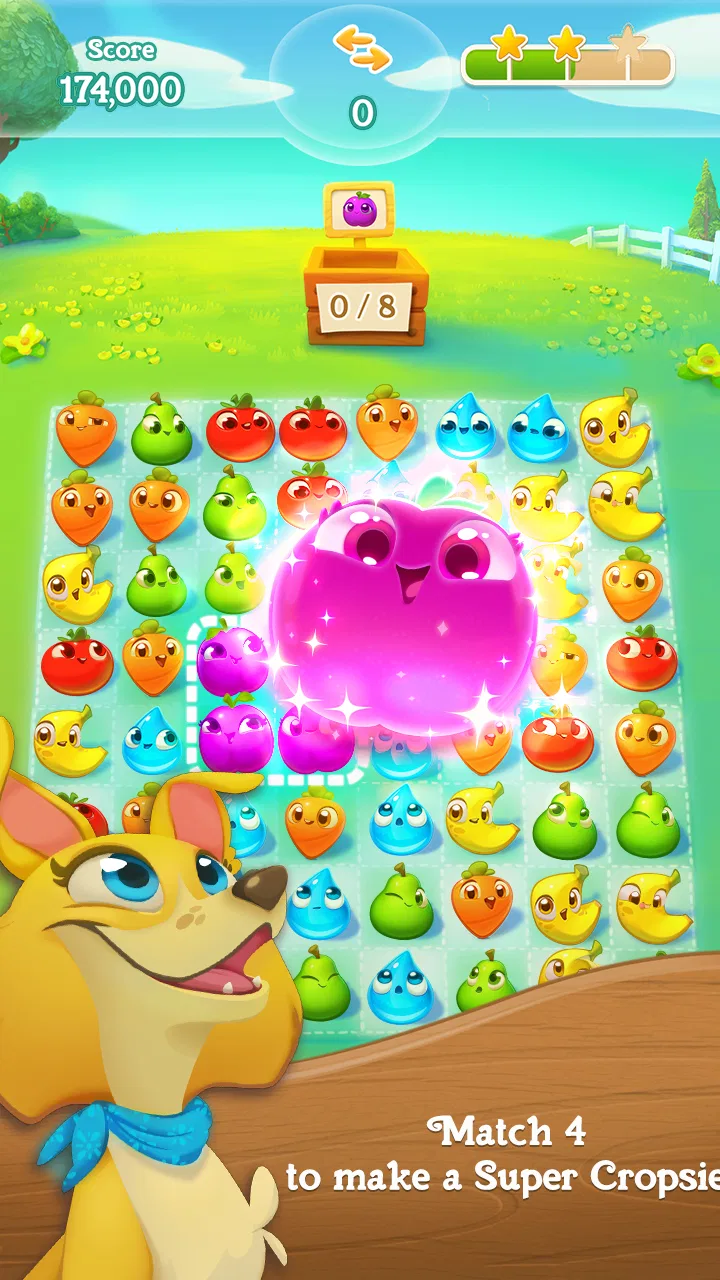
Farm Heroes Super Saga
- 4.7
- Rating
- 50.00M
- Installs
- Free
- Price

 Analysis by App-foxy
Farm Heroes Super Saga is the kind of casual puzzle game I can open for a few minutes while waiting for an appointment and still feel that I have made progress. It uses a familiar match-three foundation, but the board is filled with cropsies rather than jewels or candies, and the farming theme gives each level a clear visual identity. Developed by King, it is free to download and aimed at Everyone, so it is easy to recommend for families, relaxed puzzle fans, and anyone who enjoys short, repeatable challenges.
My first impression was that it looks simple enough for almost anyone to understand immediately. You switch neighboring pieces to create matches, collect the required cropsies, and work toward the level objective. The early stages teach the basic rhythm without making the player study a manual. What becomes interesting later is not learning a complicated control scheme, but learning to read the whole board before making a move. That small change in habit separates casual play from genuinely efficient play.
How the everyday puzzle loop works
The basic workflow is pleasantly direct. I start by checking what the level is asking me to collect, then I scan the board for matches that help that objective rather than automatically taking the first obvious combination. A move can be attractive because it creates a large group, but it may also remove a useful setup or leave the important cropsies stranded in awkward places. Taking a second to look around the entire grid usually pays off.
You May Also Like

 AccuWeather: Weather Radar
AccuWeather Review: A Quick, Clear Forecast for Everyday Decisions
For everyday plans, the best forecast is the one you can understand quickly. AccuWeather makes rain timing, radar, and local conditions easy to act on, with a few trade-offs.

 Hill Climb Racing
Why Hill Climb Racing Still Turns Crashes Into One More Run
A tiny car, a bumpy hill and one more upgrade: Hill Climb Racing keeps resurfacing because its simple chaos makes every near-miss feel personal.

 AliExpress - Shopping App
AliExpress Makes Global Shopping Feel Personal, but Shoppers Bear the Risk
AliExpress turns a global marketplace into a pocket-sized discovery engine. Its reach is useful, its shopping loop compelling, and its trade-offs easy to miss.

 Lords Mobile: Kingdom Wars
Lords Mobile Is a Kingdom-Building Routine, Not a Quick Match
A case-by-case verdict on the building, battles, device demands, and social commitments that make Lords Mobile rewarding for some players and exhausting for others.

 PDF Scanner app - TapScanner
TapScanner Makes Paperwork Easier to Capture, Check, and Share
TapScanner makes scanning with a phone feel less like a rescue operation and more like a dependable step in getting work done. Its capture tools are useful, though not flawless.

 Block Blast!
 Shows How Much a Puzzle Game Can Leave Out
A quiet grid game shows why puzzle players increasingly value instant clarity, repeatable skill and low-pressure play—and where the genre still needs to catch up.
More From Our News Desk
View All News


That is where the game feels more thoughtful than its cheerful presentation suggests. A match is not only a way to clear pieces; it changes the shape of the board and can improve or damage the next few turns. When I focus only on the nearest match, I often end up reacting to the board. When I plan one move ahead, I have a better chance of building a chain that supports the level goal.
The farming theme also makes the collection target easy to understand at a glance. I do not need to remember a complicated inventory or interpret a dense interface. The visual language tells me what matters, and the board remains readable even when several colors and effects are active. That clarity is one reason the game works well in short sessions.
A realistic everyday use case is a commute or a short break when I want something more engaging than scrolling but do not want to begin a long story-driven game. One or two stages can fit into that kind of gap. The trade-off is that a difficult level can make a “quick” session longer than planned, especially if I am close to completing the objective and want one more attempt.
The game has a 4.7 average from around 1.2 million ratings, and it has passed 50 million installs. Those figures fit my experience of it as a widely accessible puzzle rather than a niche strategy title. It is familiar enough to start quickly, but the later decision-making gives experienced players something to optimize instead of merely tapping through identical boards.
Settings I check before settling into a session
I do not treat the settings screen as an afterthought. On a mobile puzzle game, small presentation choices affect whether the board feels comfortable during a long session. I check the available sound and notification controls first, particularly if I am playing in a waiting room, on public transport, or beside someone who is working. Being able to keep the visual feedback while reducing interruptions makes the game much easier to use discreetly.
I also pay attention to how the game behaves around optional purchases. Farm Heroes Super Saga is free, but its in-app purchases range from $0.99 to $119.99 per item. That is a significant range, so I recommend reviewing purchase controls on the device before handing it to a child or allowing unsupervised play. The game is suitable for Everyone, but an age rating does not replace sensible household spending safeguards.
For my own routine, I prefer to play with notifications limited and the device volume low. That keeps the game in its proper role: a small puzzle break rather than something that constantly calls me back. If you are sensitive to visual movement or sound effects, adjusting the phone itself can also help, because the enjoyment comes from planning the board, not from turning every effect up.
Compatibility is worth checking before installing. The current version is 3.1.1.0 and requires Android 6.0 or later. That makes it a practical choice for many older Android phones, although the experience can still vary with screen size, available storage, and general device performance. On a smaller display, I find that taking deliberate taps matters more, especially when several possible matches sit close together.
I would not choose this game if I need a completely offline, uninterrupted puzzle experience with no account or service-related considerations. Its appeal is tied to a connected mobile-game style, progression, and optional spending. Someone looking for a self-contained logic app with no distractions may be happier with a traditional standalone puzzle game, even if that alternative has fewer colorful rewards.
Repeatable habits that make moves faster
My most useful habit is to scan in a fixed order. I first look for the required cropsies, then inspect the bottom of the board, and finally check whether a move can create a larger follow-up. Looking at the lower area early is helpful because clearing pieces there can cause the upper sections to shift, opening opportunities that were not visible at the start.
I also avoid spending my best move on a small match just because it is immediately available. If two moves both contribute to the objective, I favor the one that leaves more open space and keeps the target pieces connected. This is a simple rule, but it prevents the common mistake of collecting a few items quickly while making the remaining target much harder to reach.
Another practical technique is to pause after every board change. Automatic cascades can create a new arrangement that deserves a fresh scan. I used to tap quickly because the game feels light and playful, but that speed often caused me to miss a better continuation. Experienced play is not about moving constantly; it is about recognizing when the board has changed enough to reset your plan.
When a level has more than one kind of cropsy to collect, I try not to treat them as separate chores. A move that helps one target while positioning another can be more valuable than a larger match that serves only one category. This is especially useful when the board begins to narrow and there are fewer ways to recover from an inefficient exchange.
I find it helpful to identify a “safe” move and a “high-upside” move. The safe option advances the objective without damaging the board. The high-upside option may create a larger chain but depends on a favorable cascade. If I have plenty of room left, I may take the risk. If the level is nearly complete, I usually choose the reliable move instead. That judgment is more important than chasing the biggest-looking match every time.
These habits are not secret shortcuts, and the game does not need them to be enjoyable. They simply make repeated attempts less random. They also explain why the title can hold my attention longer than a basic match-three clone: the rules are familiar, but the value of each move changes with the board position and the remaining target.
Where the challenge becomes less forgiving
The main limitation is that the game’s cheerful simplicity can hide how much a difficult board depends on its starting arrangement. Sometimes the available moves do not give me the clean setup I want, and the level becomes a matter of adapting rather than executing a perfect plan. That can be satisfying when the recovery works, but frustrating when progress depends on seeing a favorable sequence.
This is also where the free-to-play structure becomes more noticeable. The game costs nothing to start, which is a genuine advantage, but players who dislike optional purchases or any pressure around retries should approach it carefully. I can enjoy the puzzle without spending, yet the experience is not designed like a paid, one-time app with every element presented in the same frictionless way.
Another limit is that the core interaction remains match-three. If you quickly tire of swapping pieces, the farming theme will not transform it into a deep simulation game. There is no reason to install it expecting crop management, building, or a detailed agricultural sandbox. The farm is the setting and personality of the puzzle, not a separate management system.
Players who want intense competition may also find it too gentle. Its strengths are accessibility, colorful presentation, and short-session progression. It is not the best fit for someone searching for a demanding tactical game where every decision has a permanent strategic consequence. Likewise, players who prefer word puzzles, nonograms, or physics challenges will not find those styles represented here.
For families, the Everyone rating makes the game approachable, but I would still explain the purchase side before letting a younger player use it. The most useful family habit is to treat the game as a shared puzzle rather than an unattended spending environment: an adult can help with difficult boards, discuss why a move is strong, and keep purchases protected at the device level.
Compared with a basic match-three alternative, Farm Heroes Super Saga has more character and a stronger sense of themed progression. Compared with a pure logic puzzle, it is more forgiving and more visually rewarding, but also more dependent on board layouts and casual-game pacing. Compared with a farming simulator, it is dramatically quicker and simpler, but it does not offer the planning depth of managing resources or a growing operation.
Who will get the most from it
I would recommend it to players who want a colorful puzzle they can understand instantly and improve at gradually. It suits people who enjoy repeating a stage to find a cleaner route, parents looking for an approachable game to play alongside a child, and casual players who prefer goals that are visible rather than abstract. The crop theme gives the familiar mechanics enough personality to feel distinct without making them difficult to learn.
It is also a good choice for someone moving from other casual games and wanting a slightly more deliberate rhythm. The first few moves are easy to grasp, but the best results come from controlling the board rather than tapping on impulse. That gives the game a useful middle ground: it is relaxing when played casually and surprisingly absorbing when I start optimizing my choices.
I would skip it if I want a purchase-once experience, a completely distraction-free logic tool, or a game built around deep long-term strategy. I would also avoid it during moments when I need to stop immediately, because the desire to retry a nearly successful stage can make a short break expand. The game is friendly, but it is still structured to encourage continued play.
Storage and device comfort matter too. On a phone with a cramped screen, the board can feel less forgiving because precise swaps require more attention. On a larger screen, the cropsies and possible matches are easier to inspect. Since Android 6.0 is the minimum operating system, older compatible devices may run it, but I would still judge the experience by responsiveness and battery comfort rather than compatibility alone.
My final view after building a routine
Farm Heroes Super Saga works because it does not overcomplicate the match-three formula. The farming presentation makes the objectives friendly, while the board gives experienced players room to develop repeatable habits: inspect the target first, look low on the board, preserve useful space, and reassess after every cascade. Those habits turn random-looking attempts into a more controlled process.
King has made a casual game that is easy to recommend, though not universally ideal. The free entry and Everyone rating make it approachable, while optional purchases and the possibility of frustrating layouts are the main points I would explain before suggesting it. I appreciate that I can play casually, but I also know exactly when it stops being a relaxing break and starts asking for patience.
After spending time with it, my verdict is positive for the right audience. Farm Heroes Super Saga is best when you want a bright, goal-driven puzzle for short sessions and enjoy improving through observation rather than complicated controls. If that sounds like your kind of game, it is worth trying for free. Just set your spending safeguards, check the sound and notification behavior that suits your surroundings, and treat each board as a small planning exercise instead of a race to make the first available match.
FAQs for Farm Heroes Super Saga
01What is Farm Heroes Super Saga?
Farm Heroes Super Saga is a colorful match-three puzzle game from King, the creators of Candy Crush Saga. You swap or match cropsies such as apples, carrots, and strawberries to complete level objectives. The game adds a farm-themed adventure, character interactions, score targets, and special cropsies that make later stages more challenging and strategic.
02Is Farm Heroes Super Saga free to download and play?
Yes, Farm Heroes Super Saga can be downloaded and played for free on supported Android and iOS devices. However, it includes optional in-app purchases for items such as extra lives, boosters, or additional moves. You can progress without spending money, although some difficult levels may require patience, repeated attempts, or careful use of the free resources provided by the game.
03Does Farm Heroes Super Saga require an internet connection?
An internet connection may be needed for downloading the game, receiving updates, synchronizing progress, displaying certain features, and completing in-app purchases. Some gameplay may work offline after the necessary content has loaded, but availability can vary by device and version. Connecting regularly is recommended so your progress and events remain properly synchronized.
04Is Farm Heroes Super Saga suitable for children?
Farm Heroes Super Saga is generally suitable for players who enjoy casual, colorful puzzle games, including families and younger users. The controls are simple, but some levels become difficult and the game contains optional purchases. Parents should review the device’s parental-control settings and disable unauthorized payments, especially if children use a shared phone or tablet.
05What are the main features of Farm Heroes Super Saga?
The game offers hundreds of match-three levels, bright farm environments, familiar cropsie characters, special combinations, boosters, score-based objectives, and progressively harder challenges. Its straightforward controls make it easy to start, while level layouts and limited moves encourage planning. Players should also expect recurring lives, timed events, and optional purchases that can affect the pace of progression.
Pros
- Bright
- cheerful graphics make the game appealing for all ages.
- New cropsies and board layouts keep later levels feeling fresh.
- Short levels are convenient for quick gaming sessions.
- Helpful boosters can make difficult stages more manageable.
- Simple controls are easy to learn without a lengthy tutorial.
Cons
- Some levels depend heavily on lucky tile combinations.
- Lives can run out quickly during repeated failed attempts.
- Boosters are limited and may encourage in-app purchases.
- Later stages can feel repetitive despite changing objectives.
- Ads and purchase prompts may interrupt the overall experience.

Farm Heroes Super Saga
Gallery